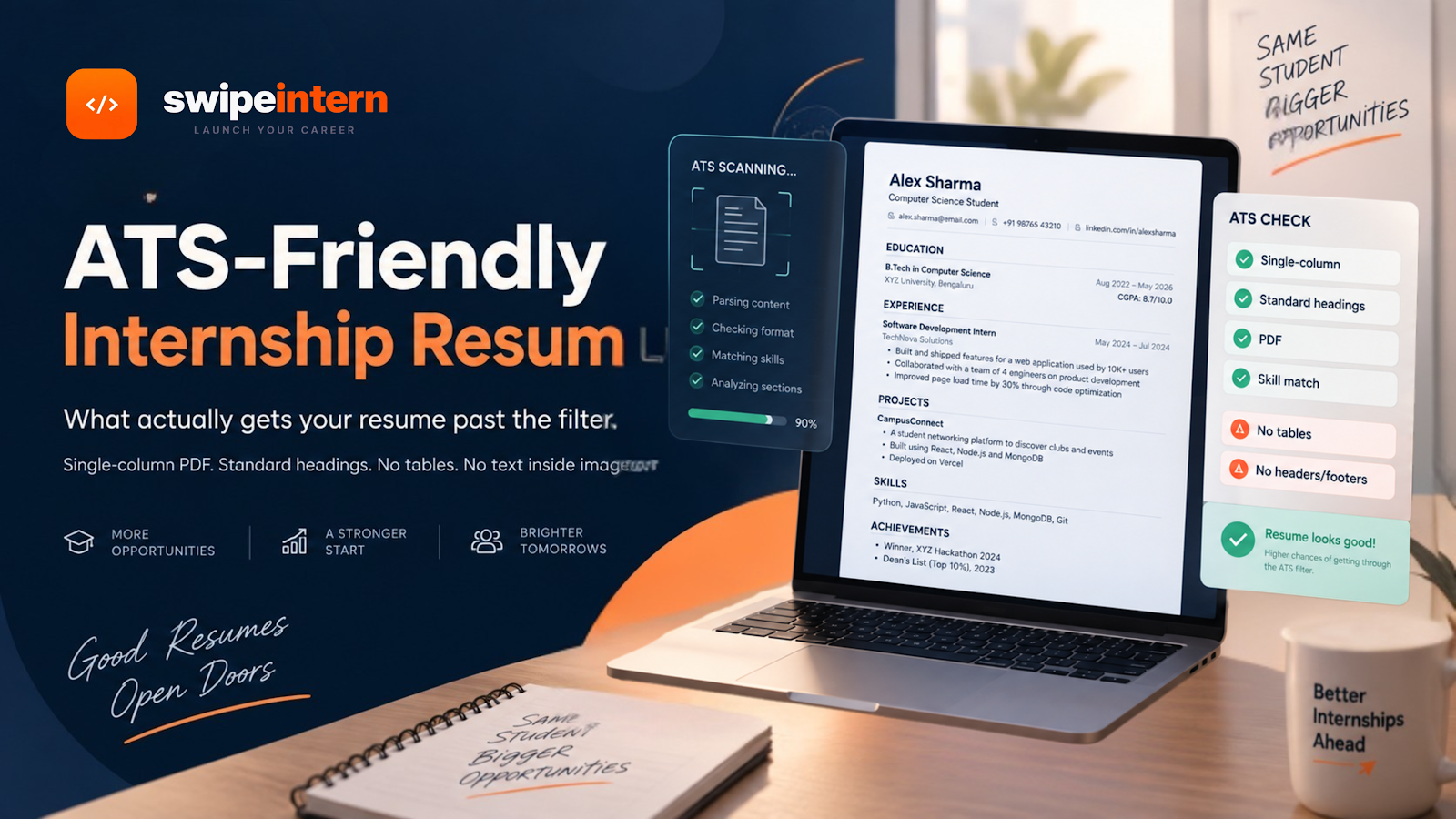
An ATS-friendly internship resume is a single-column PDF with standard section headings, no tables, no text inside images, no headers or footers, and skill terms written exactly as the job listing writes them. Applicant tracking systems extract text and map it to fields; anything that interferes with plain text extraction reduces your score before a human reads a word.
What an ATS actually does with your resume
An applicant tracking system is database software. When you upload a resume, it does three things in sequence: extracts the raw text, sorts that text into fields it recognises (name, education, skills, employment history), and scores the result against the requirements attached to the listing.
Nothing about this process evaluates whether you are good. It evaluates whether your document is readable and whether it contains the terms the listing asked for. A brilliant candidate with a broken layout scores below an average candidate with a clean one.
This matters more for internships than for senior roles, because internship postings attract volume. A single listing can draw several thousand applications, and no team reads several thousand documents by hand. The filter does the first cut.
The seven things that break parsing
1. Two-column layouts
The most common and most damaging error. A parser reads a page in a single pass. When your skills sit in a narrow sidebar next to your experience, the extracted text interleaves the two — a line of sidebar, a line of body, repeating. The output is unusable and your resume scores near zero on content matching.
Most free templates on Canva and most "modern" Word templates are two-column. This is the single change worth making before anything else.
2. Text inside images or icons
If your phone number sits next to a small phone icon that is part of an image, or your name is rendered as a graphic, the parser cannot read it. Recruiters have no way to contact candidates whose contact details did not extract.
3. Tables
Tables used for layout — a common trick for aligning dates against roles — extract inconsistently. Some parsers read them cell by cell in the wrong order. Use plain paragraphs with tab stops instead.
4. Headers and footers
Many parsers ignore the header and footer regions of a document entirely. Students who put their name and contact block in the header lose both.
5. Non-standard section headings
Parsers match headings against a known list. "Work Experience", "Education", "Skills", "Projects" are recognised. "My Journey", "What I Bring", "Things I've Built" are not, and the content underneath them may not be assigned to any field.
6. Wrong file format or file name
Submit a PDF unless the listing specifies otherwise, and generate it by exporting — never by scanning or screenshotting. A scanned PDF is an image, and an image contains no extractable text. Name the file Firstname-Lastname-Resume.pdf.
7. Vocabulary that does not match the listing
Matching is frequently literal. A listing asking for "React.js" may not credit "ReactJS". A listing asking for "Google Analytics" may not credit "GA4". Read the posting and mirror its exact terms for anything you honestly have.
This is not keyword stuffing, and stuffing is counterproductive — a wall of technologies you cannot discuss will end your first interview in four minutes. Mirror the terms that are genuinely true of you.
The ten-minute fix
That final test is the only ATS check you actually need, and it is free. Every "ATS scanner" tool that charges for a score is approximating what you can verify yourself in thirty seconds.
What ATS optimisation cannot do
Being readable gets you into the pile. It does not get you the internship. Once your resume parses cleanly, the deciding factor is content — specifically, whether your projects section shows evidence of work rather than a list of coursework.
Students often over-invest in formatting and under-invest in having something to format. If your resume parses perfectly and still gets no replies, the problem has moved from the file to what is in it, and the fix is building something worth listing.
Where the format comes from
If you are rebuilding your resume from scratch, start with the structure rather than the styling. Our internship resume format guide covers the six sections, the order they belong in, and a copy-paste template that is single-column by default.
How SwipeIntern handles this for you
SwipeIntern parses your resume once, into a structured profile — skills, projects, branch, graduation year — then matches that profile against internship listings aggregated from across the internet. You see why each listing matched, and you stop re-tailoring a document for every application.
Because the parse happens on upload, you also find out immediately whether your resume is machine-readable at all.
Upload your resume to SwipeIntern and see how it parses →
Frequently asked questions
Do all companies use an ATS for internships?
No. Large companies and any listing routed through a careers portal almost always do. Small businesses and startups hiring interns directly often review resumes by hand. Formatting for the machine costs you nothing with a human reader, so the safe assumption is that a system is reading first.
Is a Word document or a PDF better for ATS?
PDF, exported rather than scanned, unless the listing explicitly asks for .docx. Modern parsers handle exported PDFs reliably, and a PDF preserves your layout across every device a recruiter might open it on.
Do ATS systems reject resumes automatically?
They rank rather than reject. A low-scoring resume is not deleted — it sinks below the point where anyone scrolls. The practical outcome is the same, which is why parsing cleanly matters.
Should I put keywords in white text to beat the ATS?
No. Parsers extract text regardless of colour, so the hidden keywords appear in the extracted output, and when a recruiter opens the document and sees the mismatch, the application is discarded and often flagged. It is a well-known trick and it fails.
Written by the SwipeIntern team. Last updated: 30 July 2026.