Internship Interview Questions for Freshers: What Actually Gets Asked in 2026
•By SwipeIntern Team
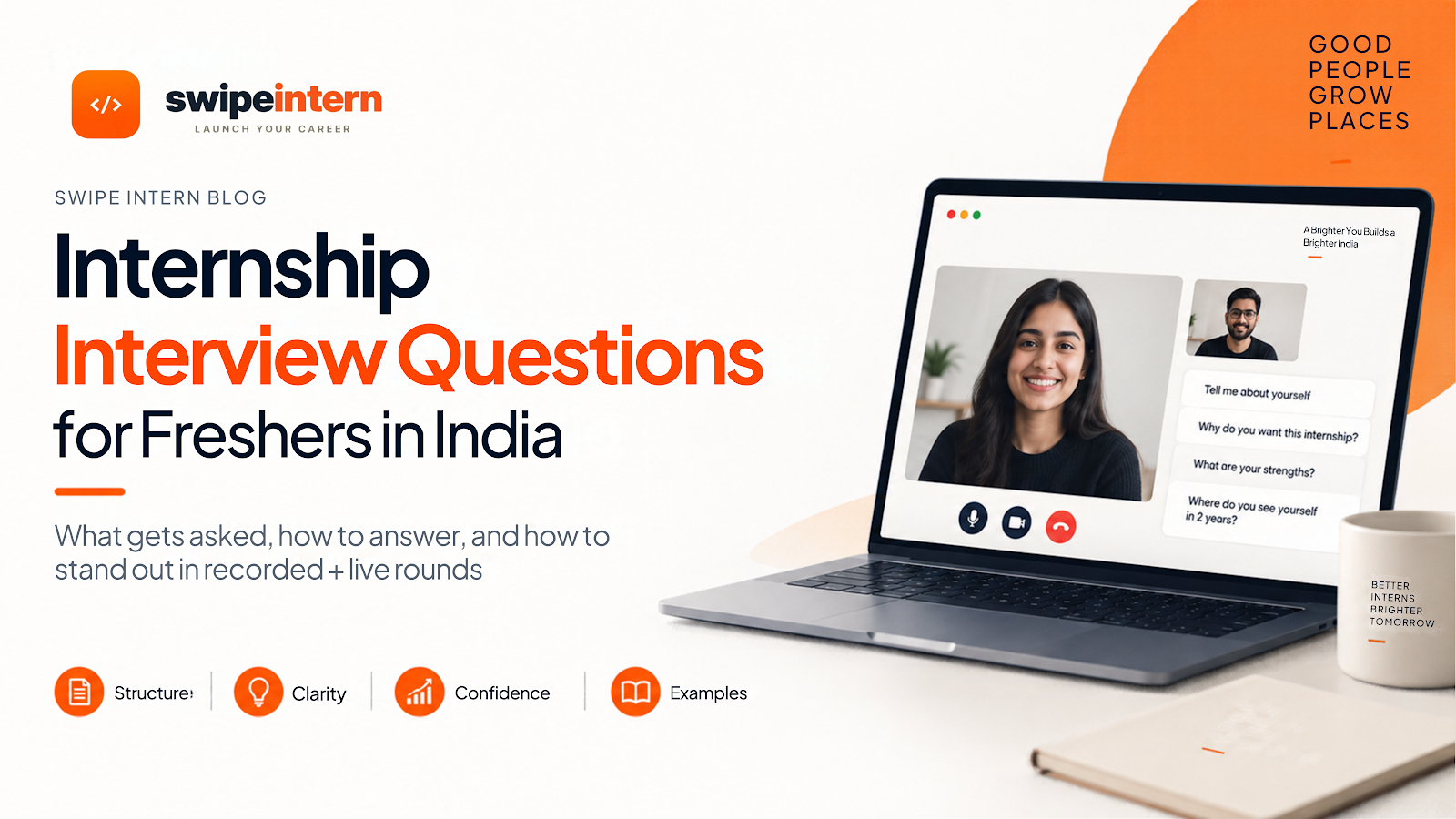
Most internship interview guides were written for a room with a person in it. In 2026, a large share of Indian fresher shortlisting never reaches that room the first round is a one-way recorded video or an automated screen where your answer is scored on structure and clarity before a human watches anything. That changes what a "good answer" looks like.
This guide covers what actually gets asked in internship interviews for freshers in India, how to answer when you have no work experience, what changes in a recorded round versus a live one, and the stream-wise technical questions that follow the HR ones. Every sample answer here is built to be spoken in 60–90 seconds, because that is usually all you get.
What an internship interview is actually testing
An intern interview is not a knowledge exam. Nobody expects a third-year student to know the job. Interviewers are screening for three things, in this order:
Almost every question below is a different door into those three rooms. Once you see that, the answers write themselves.
The four rounds you will actually face
1. The HR phone screen (5–10 minutes)
Often the first contact, sometimes unscheduled. They confirm your availability, location, duration, stipend expectation, and whether you can string a sentence together. Keep your phone answered professionally for two weeks after you apply — a surprising number of students lose internships by picking up with "haan, kaun?"
2. The one-way recorded video round
You get a question on screen, roughly 30–60 seconds to think, and 2–3 minutes to record. No interviewer, no nodding, no follow-up question to rescue a rambling answer. This is where unprepared candidates lose most, because there is no human to read your effort — only the recording.
Three rules for this format: answer the question in your first sentence, give one specific example, and stop early. Silence at the end reads as confidence. Filling the full three minutes with padding reads as waffle.
3. The task or technical round
For most internships this is a small assignment: write a post, build a page, clean a dataset, make a pitch deck. Do it, and do it on time. A slightly weaker submission delivered in 24 hours usually beats a better one delivered in five days.
4. The manager or founder conversation
The final round at a startup is frequently informal and looks like a chat. It is not. They are testing whether you will be low-maintenance and whether you actually want this specific role.
The 12 questions asked in nearly every internship interview
1. "Tell me about yourself."
The most common question and the most commonly wasted one. Do not narrate your biodata. Use a three-beat structure: where you are now, what you have built, why you are here.
Sample: "I'm in my third year of BBA at RTMNU, focused on marketing. Over the last eight months I've run the Instagram account for my college's entrepreneurship cell — took it from 400 to about 2,300 followers by switching to a fixed posting schedule and reels. I'm applying here because this role is hands-on social media execution, which is exactly what I want to get better at with actual client accounts."
Under 45 seconds. Ends by pointing at the job.
2. "Why do you want this internship?"
Say something that could not be copy-pasted into another application. Name one specific thing about the company or the role — a product, a campaign, a market they work in. Generic answers about "learning opportunity" and "reputed organisation" are invisible.
Sample: "Two reasons. The role is content plus analytics, not just posting, and I want to learn the measurement side. And you work mostly with D2C brands — I've only worked on college accounts, so I want to see how it's done when there's revenue attached."
3. "You have no experience. Why should we take you?"
Do not apologise, and do not oversell. Convert the question into evidence plus a low-risk promise.
Sample: "I haven't interned before, that's fair. What I have done is build three landing pages end to end, including one for a local coaching class that's live. I know I'll be slow in the first two weeks. After that I don't need to be told the same thing twice."
The highest-value question in the whole interview and the one students prepare least. Structure it as: the problem, what you chose to do, what broke, what the outcome was.
Interviewers push on the "what broke" part deliberately. A candidate who says nothing went wrong is either lying or did not build it. Have one real failure ready and what you did about it.
5. "What are your strengths and weaknesses?"
For strengths, pick one and attach proof. For weaknesses, name a real one and the system you use to manage it. "I'm a perfectionist" is a dead answer that every interviewer has heard several hundred times.
Sample weakness: "I under-communicate when I'm stuck. I'd sit on a problem for two days trying to solve it alone. Now I give myself a rule — if I'm blocked for more than three hours, I message and ask."
6. "How do you handle deadlines with college going on?"
This is the will-you-disappear question. Be concrete about your actual availability instead of promising everything.
Sample: "Classes end at 2 pm, so I'm free from 3 pm onwards on weekdays and most of the weekend. I have exams in the first two weeks of November — I'd tell you a month in advance and finish work ahead of schedule around that."
Naming your exam weeks upfront makes you more trustworthy, not less. The interviewer already knows you have exams.
7. "Tell me about a time you worked in a team / had a disagreement."
College projects, fests, and club work all count. Use the situation, action, result shape and keep it to one story. End on what got resolved, not on who was wrong.
8. "What do you know about our company?"
Spend ten minutes before the interview on their website, their last five social posts, and their LinkedIn page. Mention one specific thing. This question exists purely to find out who bothered.
9. "What is your stipend expectation?"
For a first internship, ask their range before naming yours: "I'd like to understand the range you've budgeted for this role." If pushed, give a band, not a number — and know the market first. Our breakdown of paid vs unpaid internships and real stipend ranges in India has domain-wise benchmarks so you are not guessing.
10. "Are you available to join immediately? For how long?"
Answer honestly and precisely. Vague availability is the fastest way to lose an offer that is otherwise yours.
11. "Where do you see yourself in five years?"
Nobody expects a real plan. They are checking whether the internship fits your direction at all. Keep it to the skill, not the designation: "Working in performance marketing, ideally on the strategy side. This role is the ground-level version of that."
12. "Do you have any questions for us?"
Never say no. It reads as disinterest and it is the easiest question to prepare. Ask two of these:
Do not open with leave policy or working hours. Ask that after the offer.
Stream-wise technical questions to expect
The 24-hour prep plan
If your resume is the weak link rather than the interview, fix that first — our internship resume format guide covers the structure recruiters scan for.
Interview red flags: when the "interview" is the scam
Some interviews are not interviews. Walk away immediately if any of these show up:
After the interview: the follow-up that actually helps
Send a short message within 24 hours, on the channel they contacted you on. Four lines, no flattery:
If you hear nothing after a week, send one follow-up. After two, move on and keep applying. Waiting on one reply while your pipeline goes empty is the most common mistake students make.
Frequently asked questions
How long is an internship interview for freshers?
Typically 15–30 minutes for a single-round internship. HR screens run 5–10 minutes; recorded video rounds are usually 20–40 minutes across several questions; technical or task rounds vary with the assignment.
What should I wear to an online internship interview?
A plain collared shirt or kurta is enough. Avoid loud prints and patterns, which look worse on a compressed video feed than in person. Dress the same for recorded rounds as for live ones.
Is it okay to say I don't know?
Yes, and it is better than bluffing. Say what you do know, then say you would look it up. Interviewers test bluffing on purpose with follow-up questions, and it always collapses by the third one.
Do I need to prepare differently for a recorded video interview?
Yes. Answer in your very first sentence, use exactly one example, and stop when you are done rather than filling the timer. There is no interviewer to follow up, so structure carries the whole answer.
Can I ask about stipend in the first round?
You can, but let them raise it first if possible. If asked directly, request their budgeted range before naming your own number.
How many internships should I apply to before expecting an interview?
Most students see a first interview call somewhere between 15 and 40 applications, depending on domain and resume quality. If you have crossed 50 with zero calls, the problem is upstream — your resume or the roles you are targeting, not your interview skills.
The part before the interview
All of this only matters if you are getting called. Volume and speed decide that, and both are usually where students lose. Applications sent within the first 48 hours of a listing going up get read; ones sent in week two often do not.
SwipeIntern pulls internship listings from across the internet into one feed, matches them to your resume, and lets you swipe through them instead of maintaining accounts on six different portals. Fewer tabs, faster applications, more interviews to actually prepare for. And if you want proof of real work to talk about in these interviews.
Start swiping, then come back to this page the night before your first call.