PM Internship Scheme 2026: Who's Actually Eligible (And What to Do If You're Not)
The PM Internship Scheme is the most-searched internship in India right now, and also the most misunderstood. The rules were rewritten twice in 2026 — the age band widened, final-year students were let in, and the stipend went up. Most pages ranking for it still quote the 2024 pilot numbers.
This guide does three things: tells you plainly whether you qualify, tells you what the scheme actually gives you, and tells you where the published numbers contradict each other so you don't get rejected on a technicality. Every rule below should be re-checked on the official portal, pminternship.mca.gov.in, before you apply — the scheme is still in a pilot phase and rules change between rounds.
The 30-second version
• Government-run internships at India's top 500 companies, managed by the Ministry of Corporate Affairs.
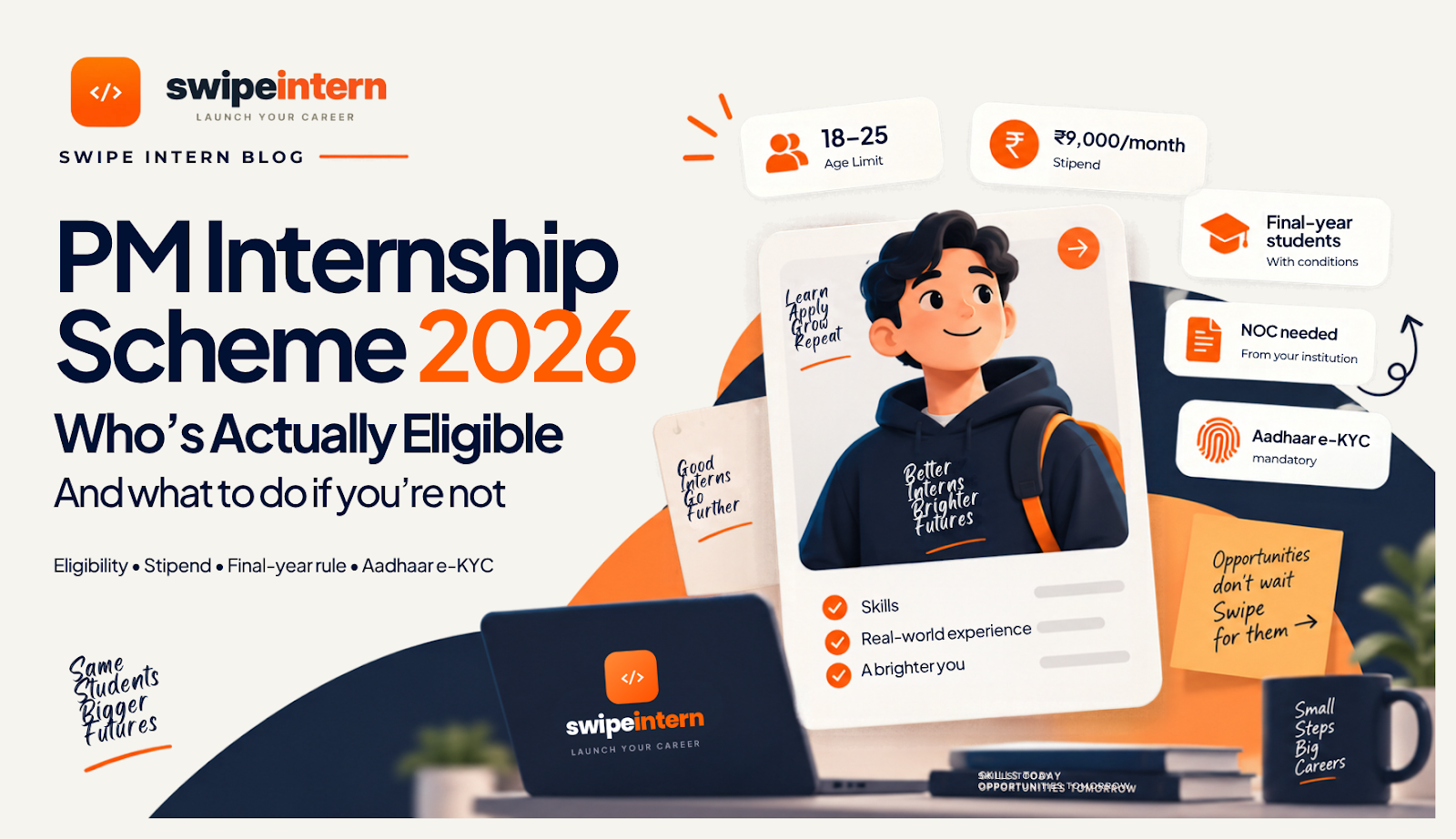
• Monthly financial assistance of ₹9,000 in the current round (up from ₹5,000 in the pilot), plus a one-time ₹6,000 grant on joining.
• Age band widened to 18–25 from the earlier 21–24.
• Final-year UG and PG students can now apply — this is new, and it needs an NOC from your college.
• Hard blocks: elite-institute graduates, professional or master's degrees, a permanent government employee in the family, and a family income ceiling.
• Aadhaar e-KYC is mandatory. No Aadhaar-linked mobile number, no application.
What the scheme actually is
Announced in the Union Budget 2024–25 and launched as a pilot in October 2024, the Prime Minister Internship Scheme (PMIS) aims to place one crore young people into internships at India's top 500 companies over five years. Those 500 companies were identified by their average CSR spending over the previous three years, and their participation is voluntary — which is why the list of live opportunities keeps changing.
The design intent is exposure, not classroom training. At least half of the internship period is meant to be spent in a real working environment rather than in sessions and modules. As of mid-July 2026, roughly 340 companies were offering about 1.22 lakh opportunities across 31 sectors.
Where the published numbers disagree — read this before you apply
Three parameters are reported inconsistently across otherwise credible sources right now, and a wrong assumption on any of them costs you the application:
• Family income ceiling. Most pages say ₹8 lakh a year. Several say ₹12 lakh. If your family income sits between those two figures, do not guess — confirm the operative number on the portal for your round.
• Age band. The 18–25 expansion is widely reported, but pages that were not updated still list 21–24. The portal's own registration form is the tiebreaker.
• Duration. Reporting on the revised scheme says 6–9 months; older material and some current pages still say 12. Read the individual listing, not the summary article.
Can you apply? The honest checklist
You can apply if
• You are an Indian citizen within the applicable age band on the date of application.
• You have passed Class 10 or higher — Class 12, ITI certificate, polytechnic diploma, or a general degree such as BA, BSc, BCom, BCA or BBA.
• You are not in full-time employment.
• You are studying through an online or distance-learning programme (these have always been allowed), or you are a final-year UG/PG student who can produce an NOC.
You cannot apply if
• You graduated from an IIT, IIM, IISER, IISc, National Law University, NID or IIIT.
• You hold a professional or higher qualification — CA, CS, CMA, MBBS, BDS, MBA, any master's degree, MPhil or PhD.
• Any family member (you, your parents, or your spouse) earns above the applicable income ceiling.
• Any family member is a permanent or regular employee of a central or state government body, a PSU, a UT administration, a statutory organisation or a local body. Contractual employees are not counted.
• You are already drawing a benefit under another government skilling, apprenticeship or internship programme, or you have already completed training under NAPS or NATS.
That exclusion list is the part people misjudge most. The government-employee rule catches a lot of applicants who assumed it only referred to themselves. Read it as: anyone in your immediate family.
The final-year student rule (the biggest 2026 change)
Until this year, being enrolled in a full-time course disqualified you outright. That is no longer absolute. Final-year undergraduate and postgraduate students can now apply, on one condition: a No Objection Certificate from your institution stating that the internship will not interfere with your academic requirements or attendance.
The NOC can be signed by your Head of Department, Dean, Principal, or Training & Placement Officer. Practical advice: start this before you find a listing you like. College administrative offices do not move at internet speed, and listings have their own deadlines. Get a signed NOC scanned and sitting in your DigiLocker or drive folder, so the document is never the reason you miss a window.
What you actually get
• ₹9,000 a month — ₹8,100 arrives by Direct Benefit Transfer into your Aadhaar-linked bank account, ₹900 comes from the company's CSR funds. This is described as financial assistance, not a salary, and you are an intern, not an employee.
• ₹6,000 one-time grant on joining, meant for incidental costs.
• Insurance cover under PM Jeevan Jyoti Bima Yojana and PM Suraksha Bima Yojana.
• A certificate tied to a recognisable company name — for most applicants this is the real prize, not the money.
What the scheme doesn't advertise
Two things worth knowing before you build your plans around this.
The offers are geographically inconvenient. Answering a question in the Lok Sabha in February 2026, the Minister of State for Corporate Affairs said a leading reason candidates decline PMIS offers is location — the travel distance applicants indicated they were willing to accept was around 5 to 10 km. These are on-site placements at company locations, and the company deciding to place you is not obliged to place you near home. Before you accept, price out rent and commute against ₹9,000 a month honestly.
Selection is competitive but not lottery-odds. In the first pilot round, over 6.21 lakh applications came from about 1.81 lakh candidates — most applicants applied to multiple listings. It's a real filter, not a formality, and applying to a single listing and waiting is the most common self-inflicted wound.
How to apply, step by step
1. Go to pminternship.mca.gov.in and register as a new user. Use the mobile number linked to your Aadhaar — OTP verification runs through it.
2. Complete Aadhaar e-KYC. This is mandatory, and it's what enables the DBT stipend later.
3. Fill your profile. The portal generates a resume from what you enter, so treat every field as resume copy, not paperwork.
4. Keep documents ready: Aadhaar, Class 10/12 marksheets, degree or diploma certificates, a passport-size photo, bank account details, and — if you're a final-year student — your signed NOC.
5. Browse listings and apply. Each listing carries its own deadline, sector, location and duration. Some rounds cap how many listings one candidate may apply to, so check the current limit before you spend your applications on the four biggest brand names.
6. Track everything on your candidate dashboard. Offers, joining instructions and communications land there, and a missed message is treated as a missed offer.
The most common reasons applications fail
• Mobile number not linked to Aadhaar, so e-KYC never completes.
• Details on the portal not matching the uploaded certificates — a name spelt differently on a marksheet is enough.
• Final-year applicants applying without an NOC in hand.
• Assuming the government-employee and family-income rules apply only to the applicant.
• Applying to one prestigious listing and treating it as a plan.
If you're not eligible — and most students aren't
Read that exclusion list again and it becomes clear how many people it rules out. If you're at an IIT or an IIIT, if a parent works for a PSU, if you hold a master's, if you're in second year rather than final year — PMIS isn't your route. That is not a verdict on your employability. It's a scheme with a narrow policy target, and you're outside it.
The private internship market is many times larger than 1.22 lakh listings, it has no income ceiling, no institute blacklist, and no year-of-study rule. It's just badly organised — scattered across a dozen job boards, company career pages, LinkedIn posts and college WhatsApp groups, which is exactly why students assume it's smaller than it is.
Whether you use PMIS or not, the same three things decide your outcome: apply to volume rather than to one dream listing, keep one clean resume that you actually tailor, and check listings weekly rather than in a panic before deadlines.
SwipeIntern exists for that middle problem. It pulls internships from across the internet into one feed you swipe through, matches them against your uploaded resume, and cuts the part of the process where you open eight tabs to find three roles you're actually qualified for. It's free, it's a web app, and it takes about two minutes to set up.
FAQ
Can final-year students apply to the PM Internship Scheme?
Yes, under the 2026 revision — final-year UG and PG students are eligible if they submit an NOC from their institution confirming the internship won't interfere with academic requirements.
What is the stipend?
₹9,000 a month in the current round — ₹8,100 from the government via DBT and ₹900 from the host company — plus a one-time ₹6,000 grant on joining.
Is Aadhaar mandatory?
Yes. Aadhaar e-KYC is required to register, and the Aadhaar-linked bank account is how the stipend reaches you.
Can distance-learning students apply?
Yes. Candidates enrolled in online or distance-learning programmes have been eligible since the pilot.
What's the last date to apply?
There isn't one global deadline. Registration stays open and individual listings carry their own closing dates, so check the portal rather than any article — including this one.
Is the internship remote?
No. At least half the internship period is meant to be spent in a real working environment at the company, which makes location a genuine factor in whether an offer works for you.