Internship Resume Format for College Students in India (2026)
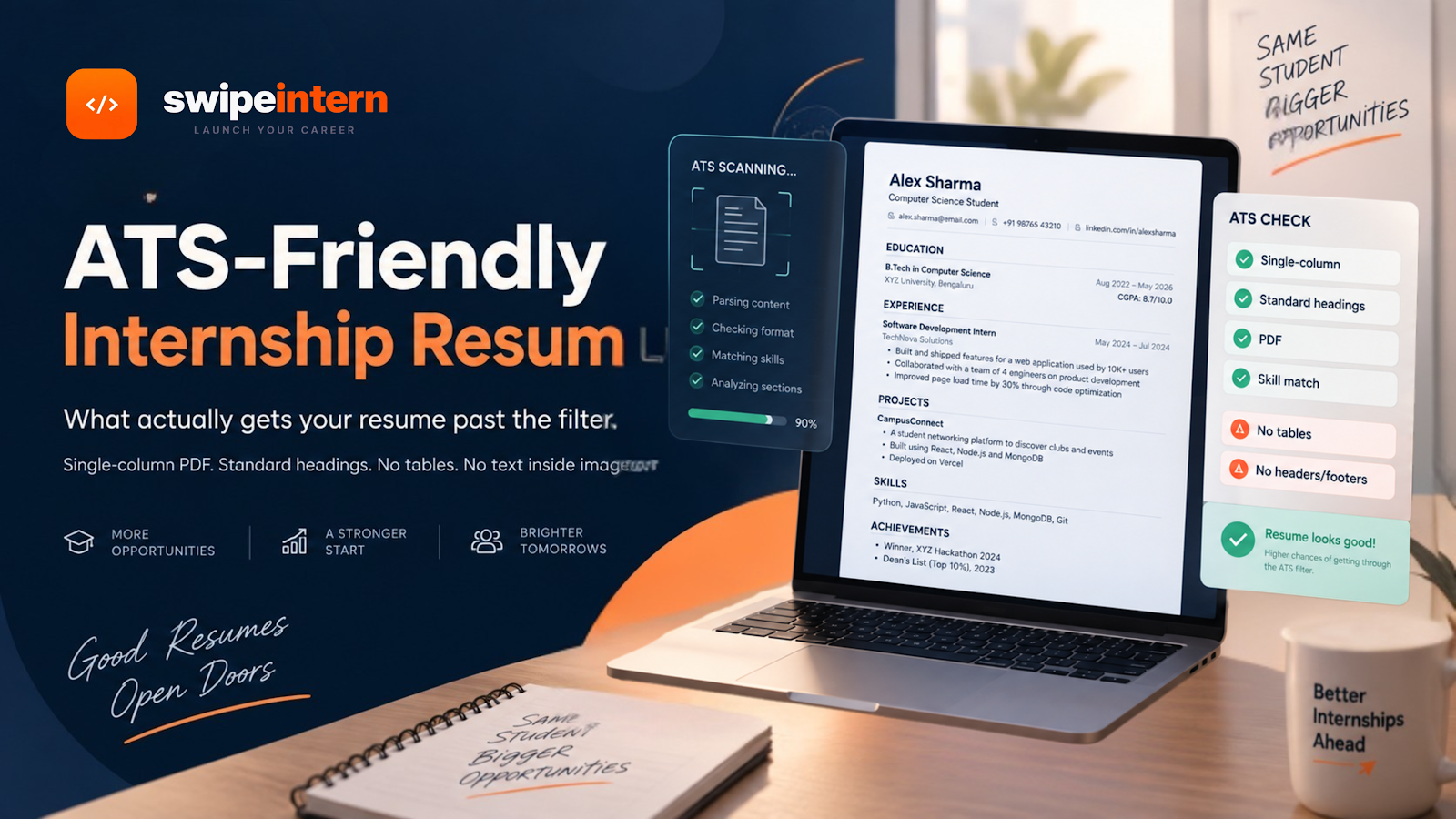
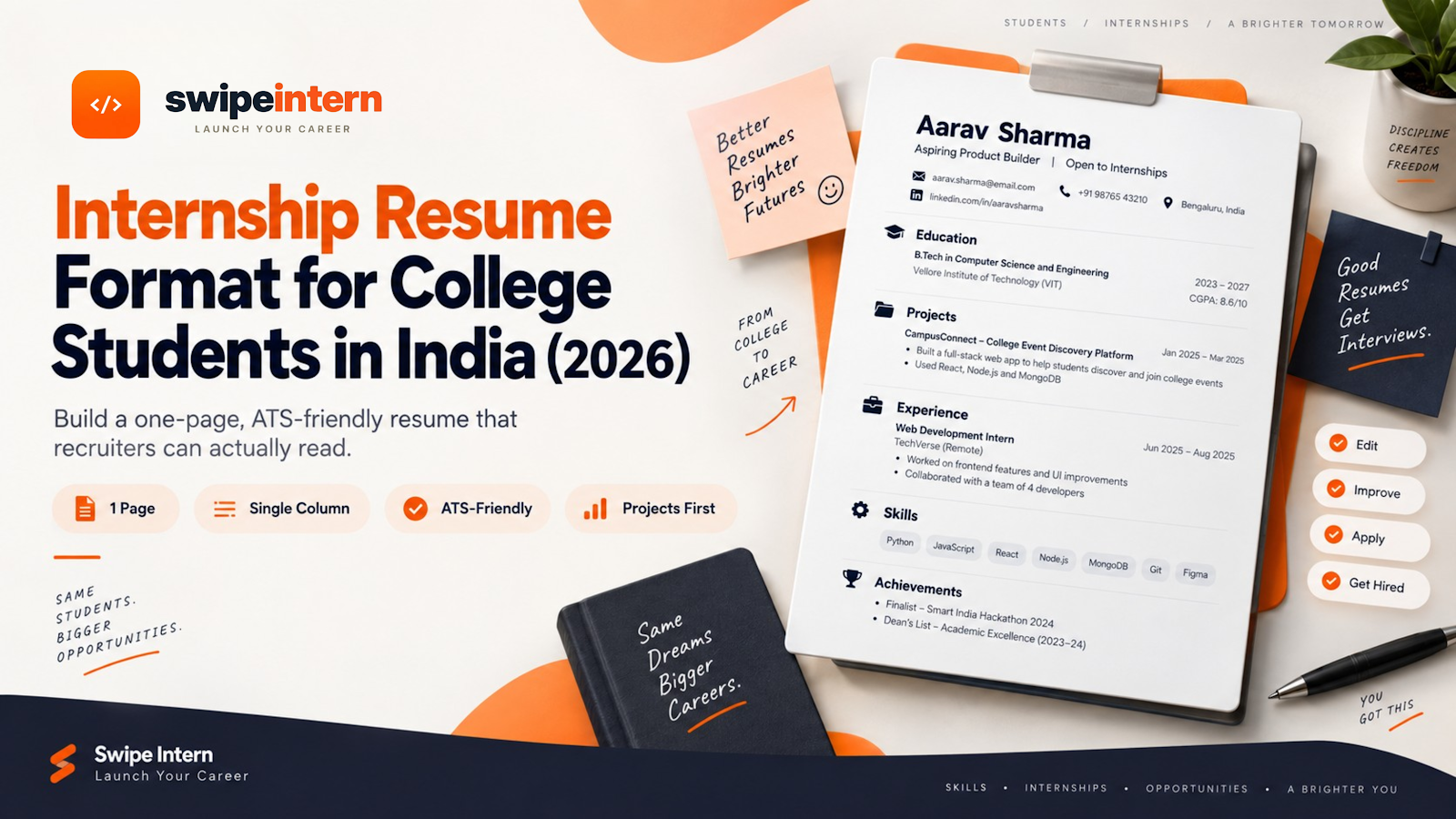
An internship resume for a college student in India should be one page, in this order: Contact → Education → Projects → Skills → Experience and Positions of Responsibility → Achievements. Single column, standard section headings, no photo, no graphics. Applicant tracking systems parse this structure reliably. Creative multi-column templates frequently fail to parse at all — which means the resume you spent four hours designing may never reach a human.
You are writing for two readers
An internship resume is not a biography. It is a one-page argument that you can do a specific task.
Two things read it. First, an applicant tracking system parses your file into fields and scores it against the job description — it reads structure. Then, if you survive that, a recruiter spends six to eight seconds on the first pass — they read outcomes.
Most student resumes fail one of those two readers. A beautifully designed two-column resume dies in the parser. A plain resume full of "was responsible for" dies with the human. The format below is built to clear both.
The six sections, in order
1. Contact block
Name, phone, email, city and state, LinkedIn URL, and a GitHub or portfolio link if you have one. Use a professional email address — firstname.lastname@gmail.com, not your college roll-number ID, and not the handle you invented in class 9.
Skip your full postal address; city and state are enough. And put this as normal text at the top of the page, never inside the document's header area many parsers ignore headers entirely, which is how students end up with a resume that has no contact details as far as the system is concerned.
2. Education
Degree and branch, college, expected graduation year, CGPA. Education sits second only while you're still studying; once you have a year of real work behind you, it moves to the bottom.
List your CGPA if it's above 7.0. Below that, leave it out and let your projects carry the weight — there's no rule forcing you to volunteer a weak number, though be ready to answer honestly if the interviewer asks.
3. Projects — your most important section
This is where a student with no work experience actually wins. Give each project three lines: what you built, what you used, what happened.
"Built a Django expense tracker with JWT auth, deployed on Railway, used by 40 classmates" beats "Worked on a web development project using Python" every single time. The first one is evidence. The second is a claim.
Two or three strong projects outperform six weak ones. And a project with a live link or a public repo counts for more than one described in prose, because a recruiter can verify it in one click instead of taking your word for it.
4. Skills
Split into Technical and Tools. Write only what you'd survive a follow-up question on — recruiters do ask, and being caught out on a listed skill costs you more than omitting it would have.
Drop the star ratings and skill bars. Parsers read them as noise, and "Python ★★★☆☆" tells a human nothing they can use.
5. Experience, volunteering, positions of responsibility
College fest coordination, a club role, a freelance gig, teaching juniors, helping digitise a family business — all of it counts. The trick is framing each one as a result, not a duty.
"Coordinated sponsorships for a 900-attendee techfest, raising ₹1.2L across 7 sponsors" is experience. "Was part of the sponsorship team" is attendance.
6. Achievements and certifications
Hackathon placements, scholarships, published work, genuinely relevant certifications. Three lines maximum, and only things a stranger would recognise as difficult. A list of twelve completion certificates reads as padding, not range.
What to write when you have zero experience
Every student starts here. The answer is never to pad — recruiters recognise inflated language instantly, and it costs you more credibility than a short, honest resume ever would.
Instead, manufacture evidence over a weekend. Rebuild a company's landing page and write up what you changed and why. Audit a local business's Google Business Profile and document the gaps. Take a public dataset, analyse it, publish the notebook. Write three case studies of campaigns you'd run for a brand you like.
Each of those becomes a legitimate Projects entry. More importantly, each demonstrates the one thing an internship recruiter is genuinely trying to establish: that you do things without being told to.
The ATS rules that decide whether you're read at all
None of this is aesthetic preference. These are the specific things that break automated parsing:
Five mistakes that get student resumes rejected
The template
Copy this skeleton into a blank Google Doc, fill it in, export as PDF:
That's the whole thing. If it runs past one page, cut the weakest project rather than shrinking the font to 9pt — the second option is obvious to everyone who reads it.
How SwipeIntern reads your resume
Once your resume is in this format, you can stop rewriting it from scratch for every listing. Upload it once to SwipeIntern and it's parsed into a structured profile — skills, projects, branch, graduation year — then matched against internships aggregated from across the internet. You swipe through the matches instead of hunting for them across five platforms, and every card shows you why it matched.
Upload your resume to SwipeIntern and see your matches →
Frequently asked questions
How long should an internship resume be?
One page. College students rarely have enough verifiable experience to justify a second page, and recruiters read a two-page student resume as a signal of weak editing judgement rather than depth.
Should I include a CGPA below 7?
No, unless the internship posting sets a minimum you meet. Use the space for a project instead. Be prepared to answer honestly if you're asked directly in an interview.
Do I need a different resume for every internship?
You need one base resume plus small edits per application. Reorder your projects so the most relevant sits first, and adjust your skills line to mirror the wording in the listing. The structure itself never changes.
Are Canva resume templates bad for internships?
Most are, because they default to two columns, icon-based contact details and text inside graphic elements — all three break ATS parsing. A plain single-column document outperforms a designed one in almost every automated screen.
What goes in a resume if I have no internship experience yet?
Projects. Self-initiated work a built app, an audited business profile, an analysed dataset, a published case study — counts as legitimate evidence, and it's stronger than padded descriptions of coursework because it shows initiative rather than attendance.
Written by the SwipeIntern team. Last updated: 1 August 2026.